
Introduction
This article was written to provide an overview of the Mathematics and Mathematical Literacy decision for parents and students in South Africa, particularly from South African IEB and CAPS schools.
Quick Answers/ Table of Contents:
- Who is Genius?
- What is the difference between Mathematics and Mathematical Literacy?
- What does Mathematical Literacy actually close?
- Which universities accept Mathematical Literacy, and for what?
- Can you do a BCom or study accounting with Mathematical Literacy?
- What careers stay open with Mathematical Literacy?
- Is 55% in Mathematics better or worse than 85% in Mathematical Literacy?
- Can you go back to Mathematics, and by when?
- What if the school is recommending the switch?
- What do we see in Grade 9 and 10 before this decision arrives?
- What does Genius do?
- FAQs
Genius Premium Tuition
Genius has been operating since 1993.
Across our history, we have helped students get into universities in South Africa and all over the world, and we have sat with a great many families on exactly this decision. We hope to give you an honest sense of what Mathematical Literacy closes, what it leaves open, and how much time you actually have to change your mind!
A note on names before we start. The official subject names are Mathematics and Mathematical Literacy. 'Core Maths', 'Pure Maths' and 'Maths' are informal shorthand for Mathematics, and 'Maths Lit' or 'Math Lit' is shorthand for Mathematical Literacy. We use the informal names here because that is what families use, but the official names are what appear on university requirement pages, so those are the words to search for.
What is the difference between Mathematics and Mathematical Literacy?
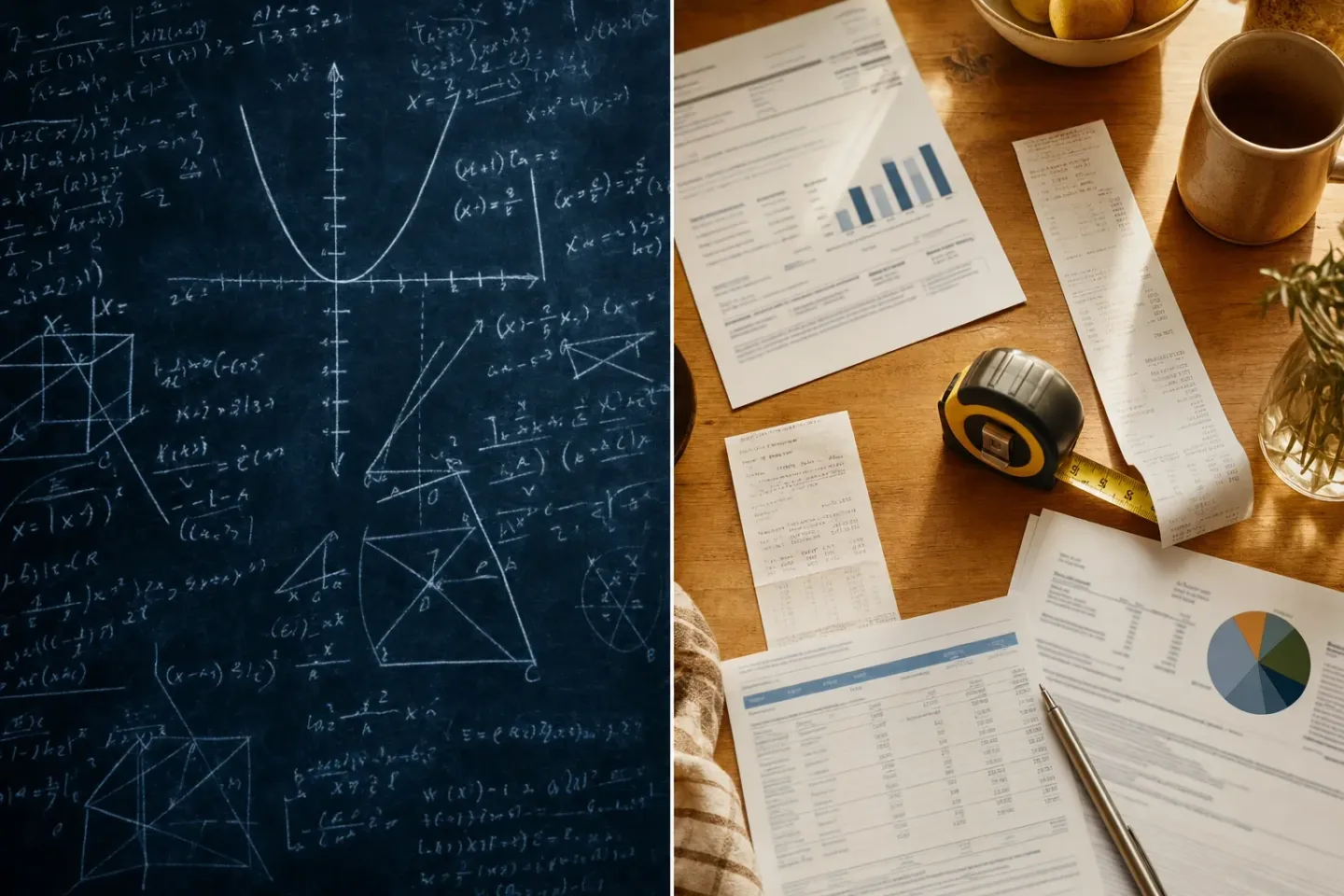
The honest answer is that they are two different subjects, not one subject at two difficulty settings.
Mathematics is abstract and cumulative. It is built on algebra, functions, trigonometry and, in matric, differential calculus. Each year rests on the one before it, which is why a gap in Grade 10 algebra tends to become a much larger problem in Grade 11 than it was when it opened.
Mathematical Literacy is applied and contextual. It is built on finance, measurement, maps and plans, data handling and probability, worked through real documents: bank statements, tax tables, municipal tariffs, floor plans, packaging layouts. It asks a genuinely difficult thing of a student, which is to read a complicated real-world document, work out which calculation is even relevant, and then justify the answer in words.
That difference in kind matters more than the difference in difficulty, because it changes who thrives:
- A student who copes well with symbols, multi-step abstraction and cumulative progression tends to do better in Mathematics.
- A student who reads carefully, interprets tables and documents well, and can explain a quantitative decision in words tends to do better in Mathematical Literacy.
Both subjects run to two final papers of 150 marks and three hours each, and in both, 25% of the promotion mark comes from the year's school-based assessment and 75% from the final examination. Neither has a practical assessment task.
One rule that catches families by surprise. Physical Sciences must be taken with Mathematics. The IEB states it plainly in its National Senior Certificate requirements: "Physical Sciences must be offered with Mathematics." So a move to Mathematical Literacy is usually a move out of Physical Sciences at the same time. That is two major subjects changing at once, and it is the single most important thing to check before anything is signed, because it is what actually closes the science and engineering routes.
What does Mathematical Literacy actually close?
Here is the part most pages will not say directly, so we will. Mathematical Literacy closes doors. Not all of them, and not permanently, but the list is real and it is worth seeing on one page before you decide.
The University of Cape Town publishes a subject-choice guide aimed specifically at Grade 9 learners, and it sorts every one of its degrees into three columns. It is the clearest published statement of the consequence that we know of, and this is the shape of it (as at July 2026, for 2027 entry):
- Mathematics and Physical Sciences both required: all of the engineering degrees (Chemical, Civil, Electrical, Electrical and Computer, Geomatics, Mechanical, Mechatronic), Construction Studies, and MBChB (Medicine).
- Mathematics required, Physical Sciences not necessarily: the whole Science faculty (including Computer Science, Mathematics, Statistics, Biochemistry, Genetics, Geology, Physics), the whole Commerce faculty (BCom and BBusSc, every stream, including Accounting, Economics, Information Systems and Management Studies), Architectural Studies, Property Studies, and the Humanities degrees built on quantitative majors such as Economics, Informatics and Organisational Psychology.
- Mathematics or Mathematical Literacy accepted: the Bachelor of Arts and its majors, the Bachelor of Social Sciences and its majors (Anthropology, Gender Studies, Philosophy, Politics and Governance, Psychology, Religious Studies, Social Development, Sociology), Fine Art, Theatre and Performance, Music, Social Work, the performing and creative arts diplomas, and Law.
Wits puts it in one sentence on its entry requirements page: "Mathematics is a core and compulsory subject for all numerate programmes in Commerce, Law and Management, Engineering and the Built Environment, Science and most of the programmes in the Health Sciences Faculty." And then, for the other side: "Mathematical Literacy will be considered for LLB, Education and Humanities (except for Speech-Language Pathology and Audiology)."
So the short version, faculty by faculty:
- Engineering: closed.
- Science, in every form, including Computer Science: closed.
- Medicine and most health sciences: closed.
- Commerce, including the accounting and economics routes: closed at the major universities.
- Humanities, Social Sciences, Fine and Performing Arts: open.
- Law: open, and this is the one that surprises people most.
- Education: open for most routes, but not for a mathematics-specialist teaching qualification.
- Some allied health programmes: open, at a higher mark. See the next section, because this is where the real detail sits.
What parents most often get wrong is treating this as a permanent verdict on the career. It is not. It closes first-year entry to those degrees. It does not close the profession, because bridging routes, extended degree programmes, transferring within a university, and doing Mathematics after matric all exist. What it costs is time and money, and usually a year of both.
Which universities accept Mathematical Literacy, and for what?
They differ, and the differences are large enough to change which university you apply to. Two live examples make the point better than any general rule.
The University of Cape Town, Faculty of Health Sciences. UCT's own admissions material sets these subject requirements. The figures below are for 2027 entry, checked in July 2026, and the rule for rolling them forward is simple: open the faculty's admission requirements page for your child's year of application and read the mathematics line for each programme.
| Programme | Mathematics | Mathematical Literacy | Minimum points score |
| MBChB (Medicine) | 70%, with Physical Sciences at 70% | Not accepted | 450 |
| Physiotherapy | 60% | Not accepted | 360 |
| Occupational Therapy | 60% | 70% | 340 |
| Audiology | 60% | 70% | 340 |
| Speech-Language Pathology | 60% | 70% | 340 |
*All five also require Physical Sciences or Life Sciences, English, and the National Benchmark Tests.
Wits. Its entry requirements exclude Speech-Language Pathology and Audiology from the programmes for which Mathematical Literacy is considered.
Read those two together, because it is the most useful thing on this page: Audiology and Speech-Language Pathology are open to a Mathematical Literacy student at UCT and closed to the same student at Wits. The same degree, the same year, the same marks, a different answer. If your child has Mathematical Literacy and a health-sciences ambition, the university list is not a detail to settle later. It is the decision.
Notice the second pattern in those UCT numbers, too. Where Mathematical Literacy is accepted, it is almost never accepted at the same level. UCT wants 60% in Mathematics or 70% in Mathematical Literacy for the same programme. That ten-point gap is the rule rather than the exception across South African universities, and it is why "we will switch and get a distinction" is a strategy that only works if the distinction actually arrives. A 55% in Mathematical Literacy does not open the doors that a 55% in Mathematics closes.
A few more things worth knowing:
- The National Benchmark Tests still apply. UCT requires the NBT for all of those health sciences programmes, and Commerce applicants write the Academic and Quantitative Literacy test. A Mathematical Literacy student is not exempt from being tested on quantitative reasoning at the door. You should start planning for the NBT towards the end of Grade 11.
- Universities of technology and private institutions are generally more accommodating, and for some careers they are a perfectly good route rather than a consolation prize. They are worth researching properly rather than dismissing.
- Requirements change every year. Everything above was checked against the universities' own published material in July 2026, for 2027 entry. Before you make a decision on it, open the faculty page for the actual year your child is applying and read it yourself.
Can you do a BCom or study accounting with Mathematical Literacy?
Mostly no, and the exceptions are narrower than the internet suggests.
At UCT, Commerce requires Mathematics. The faculty asks for at least 60% in Mathematics for a general BCom, 70% for Computer Science and Analytics, and 80% for Actuarial Science. Mathematical Literacy is not sufficient, and UCT's own advice to applicants studying Mathematical Literacy is to look at Humanities instead. At Wits, Commerce sits inside the "numerate programmes" for which Mathematics is compulsory.
Accounting is stricter again. The University of Johannesburg's BCom in Accountancy states the requirement as Mathematics at level 4, and adds, in brackets, "please note that Mathematical Literacy is not accepted."
Where it does open up:
- Some management-side and information-systems streams at some universities will consider a high Mathematical Literacy mark, in the 70s or 80s, usually alongside a higher overall points score than a Mathematics applicant would need.
- Extended and foundation programmes exist at several universities, running the degree over four years instead of three, and some of them accept Mathematical Literacy at a strong mark. They are a genuine route into commerce.
- Diploma and higher certificate routes in accountancy, bookkeeping and financial services accept Mathematical Literacy widely, and they articulate upwards into degree study.
What that adds up to is this. If your child wants to be a chartered accountant, Mathematical Literacy is the wrong subject and there is no comfortable way to say otherwise. If your child wants to work in business, it is not.
What careers stay open with Mathematical Literacy?
This is the most-searched version of the question, and the honest framing is not a list of jobs. It is a direction.
Mathematical Literacy channels a student towards fields where strong applied numeracy is enough, rather than locking them out of employment. In practice that means the humanities and social sciences, law, most teaching routes, social work, psychology, media and communications, the creative and performing arts, human resources, marketing, tourism and hospitality management, many public-sector and administrative careers, and a wide range of allied health and vocational qualifications through diplomas and universities of technology.
What it does not support is anything that needs formal algebra, calculus or science-linked mathematics in first year: engineering, the physical and computational sciences, actuarial work, chartered accountancy, medicine, and quantitative finance.
Two things are worth holding on to here.
The first is that careers rarely run on the plan. We have watched students take Mathematics and Physical Sciences, get the marks, start the degree that the plan called for, and discover in second year that they hate it. Subject choice at 15 is a decision about keeping options open, not a career contract, and treating it as a contract puts a weight on a child that the decision cannot carry.
The second is the sentence that we would most like a worried parent to take from this article, and it comes from one of our own Education Leaders, who says it to families often: a lot of people believe Mathematics will open more doors, and it will. But if your child is failing Mathematics, those doors are already closed. A 29% in Mathematics does not keep engineering open. It keeps the anxiety open. The comparison that matters is not Mathematics against Mathematical Literacy in the abstract, it is the realistic Mathematics mark against the realistic Mathematical Literacy one.
Is 55% in Mathematics better or worse than 85% in Mathematical Literacy?
This is the calculation almost every parent attempts in their head, and it is worth doing properly, because the answer is genuinely counter-intuitive.
Take Wits, which publishes its points scale. Mathematics and English are scored on a boosted scale, gaining two extra points from 60% upwards. Every other subject, including Mathematical Literacy, is scored on the ordinary scale. Life Orientation is scored on a reduced scale of its own.
- 55% in Mathematics: 4 points. The 50 to 59% band earns no bonus.
- 85% in Mathematical Literacy: 7 points, on the ordinary scale.
Nadia is applying for a Bachelor of Arts. Her other six subjects give her English Home Language at 72% (8 points), Afrikaans First Additional Language at 68% (5), Life Sciences at 65% (5), History at 70% (6), Geography at 66% (5) and Life Orientation at 75% (2), which is 31 points before her mathematics subject.
- With 55% in Mathematics, Nadia's Wits points score is 35.
- With 85% in Mathematical Literacy, it is 38.
So on the points score alone, and for a degree that does not require Mathematics, 85% in Mathematical Literacy beats 55% in Mathematics, and it is not close. Three points is often the entire margin between clearing a faculty cut-off and missing it.
Now the other side of the same scale, which is the part nobody mentions. 60% in Mathematics scores 7 points at Wits, exactly the same as 85% in Mathematical Literacy. Those five percentage points between 55% and 60% in Mathematics are worth three points. Remember, there is a huge difference in the effort and attention applied between 55% and 60%, and no difference at all between 55% and 59%. This is the sort of thing we look for when we work out where a student's hours should go, and there is more on it in our article on the APS and how universities calculate it.
Three caveats, and they are the whole argument:
- If the degree requires Mathematics, the points are irrelevant. A student with 85% in Mathematical Literacy and a beautiful points score is still not eligible for a BCom at UCT. Points get you considered. Subject requirements get you in the door, and they are checked first.
- 55% in Mathematics is not a ceiling, it is a foundation. A student sitting at 55% in Grade 10 or 11 has understood a great deal. In our experience that student is far more often a candidate for improvement than for a subject change, and switching in order to convert a workable 55% into a comfortable 85% trades a real option for a points gain. The 55-versus-85 question is only a real question at the very end, in matric, when the mark is what it is.
- The content matters after school, not just the points. A student with 55% in Mathematics has met functions, algebra, sequences and the beginnings of calculus. A student with 85% in Mathematical Literacy has not. If the degree has any mathematics in first year, even a degree that admitted them without Mathematics, that gap arrives in March of first year and it is a difficult one to close while the course is running.
Can you go back to Mathematics, and by when?
Yes. And the deadline that matters is not the one on the school's form.
The administrative answer is that schools generally allow a change of up to two subjects, with the principal's written approval and the parents' written consent, and that the window narrows every year, with Grade 12 heavily restricted and requiring approval from the examination body itself. The exact dates differ by province, by examination board and, in practice, by school. Ask your school for its deadline in writing, and do it before you need it.
Our answer is different, and firmer. We recommend that the decision to return to Mathematics is made by the end of Grade 10.
Here is the reasoning. A student who moves back at the end of Grade 11 is not catching up two years of work. Most schools teach a meaningful chunk of the matric syllabus during Grade 11, so by the end of that year the class is already two or three months into matric content.
That makes the real catch-up closer to two and a half years, and the only window available to do it in is a December and a January. It can be done, and we have seen it done. It requires something close to full-time tuition over the holiday, and it usually costs the student every other subject's momentum in the process.
The same reasoning, in reverse, is why an early move is far more manageable. A student going back in Grade 10 has a gap measured in months, not years, and can be caught up in the background while the school year carries on, which is much less brutal than being dropped into a Grade 11 Mathematics class with a Grade 9 foundation.
If you are already past that point, our recommendation is not to switch back in Grade 11 or matric. It is to finish the National Senior Certificate with Mathematical Literacy, protect the rest of the marks, and then take Mathematics as a single subject after matric. It costs a year, which is the thing families most want to avoid, but it is a year spent with Mathematics as the only thing on the desk rather than a year spent watching seven subjects slide at once. We write about both routes in our pages on rewriting matric and rewriting a single subject.
Some other things we have learned about going back:
- Ask whether the school runs both subjects. Some schools let a student carry Mathematics and Mathematical Literacy together for a period, which is the safest possible version of this decision, because it keeps the option open while you find out what the child can actually do. Many schools do not offer it, and the reason is usually teacher resourcing rather than policy. It is worth asking directly, and worth asking early.
- Hours are the variable, not willingness. An hour a week does not close a two-year foundation gap. If a family cannot commit to serious hours, including holidays, the honest conversation is about a different plan rather than a heroic one.
- Something has to give, and it should be named out loud. We regularly meet families who want extensive mathematics tuition and also want the child to continue with every sport, every ensemble and every tournament. Both are reasonable wishes and they are not compatible in the same term. The reason to say it plainly at the start is that if nothing is dropped, it is usually the other six subjects that quietly absorb the cost.
- Whose decision is it? If a student is going back to Mathematics because of parent pressure, or because of the stigma attached to Mathematical Literacy, rather than because of something they actually want to study, it tends not to work. A student who does not believe they are capable of the subject will struggle to do the volume of work that going back requires.
What if the school is recommending the switch?
Take it seriously, and take it in context. Both halves of that sentence matter.
Most recommendations to move a child into Mathematical Literacy are made in good faith, by a teacher who knows the child, has taught them for two years and has watched the marks go the wrong way. That is real information from someone with a close view, and it should carry weight.
It is also worth understanding the position the school is in, because we think parents are entitled to see the whole picture rather than half of it.
A school's matric results are public. They are how it is judged by the department, by prospective parents and by its own governing body, and the Mathematics pass rate is one of the most visible and least flattering numbers a South African school produces. Nationally, the pressure this creates is no longer subtle. Announcing the 2025 results in January 2026, the Minister of Basic Education noted that "only 34% of candidates wrote Mathematics, while most wrote Mathematical Literacy. This is concerning as Mathematics is an important gateway subject." Roughly two thirds of the country's matrics now sit Mathematical Literacy, and that is the outcome of a great many individual conversations exactly like the one your family may be having.
We want to be clear about what we are and are not saying. A school that moves a struggling student into Mathematical Literacy is very often doing the right thing for that student. It is also, at the same time, protecting a number it has every reason to protect. Those two things are not in conflict, and neither of them is sinister. Any organisation measured on a statistic will feel the pull of that statistic, and a school is no different. It is simply worth knowing that both things are true at once, because only one of them is about your child.
So our advice is not to distrust the recommendation. It is to ask what it rests on:
- Which topics, specifically? Algebra and fractions are structural. One weak statistics test is not.
- Over what period? One difficult term is a term. Two years below 50% is a pattern.
- What support has actually been tried, by whom, for how long, and did the mark move at all?
- Would the school allow the child to carry both subjects for a while, so the decision does not have to be final today?
If the answers describe two years of foundation gaps that have been worked on and have not shifted, the recommendation is very probably right, and taking it is not a defeat. If the answers describe one bad term and no intervention, you are being offered a permanent solution to what may well be a temporary problem, and it is entirely reasonable to say that you would like to try something else first.
What do we see in Grade 9 and 10 before this decision arrives?
By the time a family is discussing Mathematical Literacy, the signals have usually been visible for a year or two. These are the ones we watch for, because they are the point at which the trajectory can still be changed cheaply.
- Which topic is failing, not just the mark. A weak probability or data-handling result is a different signal from a weak algebra result. Algebra and fractions are structural: they are what everything after them is built on. A child failing algebra in Grade 10 needs attention now, and a child who lost marks on one statistics test probably does not.
- The Grade 8 to Grade 9 transition. Grade 9 is where mathematics stops being recognise the formula and apply it and starts being manipulate the formula and see how the pieces connect. A student who was fine and is suddenly not fine has very often hit exactly that shift, and it is a teachable gap rather than a ceiling. We have seen students at 20% in Grade 9 come right once that one idea lands.
- Two consecutive years below 50%. One bad year is a year. Two is a pattern worth investigating properly.
- The other numerate subjects. If Physical Sciences and Accounting are healthy and only mathematics is falling, mathematics is probably not the real problem. If all of them are sliding together, that is a different diagnosis.
- Capacity, not just ability. If a student is pouring everything into mathematics and the other six subjects are dropping to pay for it, and mathematics is still not improving, the issue is capacity. That is worth naming honestly, because a switch made for capacity reasons is often a good decision and a switch made for ability reasons often is not.
- How the child feels about the subject. A student can be doing well and still be frightened of mathematics. Persistent anxiety around the subject, complaints about the teacher, avoidance of the homework: in Grades 8 and 9 those are early warnings, and they are much easier to address then than in Grade 11.
- What an educational psychologist's report says about working memory. Where a student has been assessed, working memory is one of the strongest indicators of how they will cope with multi-step mathematics. It is worth asking about specifically.
What changes the trajectory is rarely one thing. Sometimes it is targeted tuition on the specific foundation gap. Sometimes it is remedial support first, from a specialist, with tuition picking up afterwards. Sometimes it is dropping a different subject to free capacity: we have had a student's mathematics mark rise around 20 percentage points after moving out of Physical Sciences, purely because the pressure came off.
Sometimes it is the home environment, or the schedule, or a psychologist. What it is almost never is one more hour a week bolted onto an unchanged week. Tuition is not a plaster you can stick over a problem that is actually about capacity, or anxiety, or what is happening at home.
Maths support and subject choice
Grade 9, before the subject choice is made, is a good time to start thinking about all of this. So is the first term of Grade 10, when the first real Mathematics marks arrive and tell you something the Grade 9 marks could not.
That's where we come in. We assess the student first: where the foundation gaps actually are, which topics are structurally weak, what the realistic Mathematics mark looks like with support, and what the degree ambitions require of it. Only then do we say anything about the subject, because the honest advice depends entirely on the answers. Sometimes we tell a family that the right move is to stay in Mathematics and put the hours in. Sometimes we tell a family that Mathematical Literacy is the better decision for that child, and we say so plainly.
We then fill in those gaps systematically through premium, one-on-one tuition with our trained in-house team of tutors. This can be done online or in person. If it is Mathematics that needs the work, our Maths tutors do this every day, across IEB, CAPS and the international curricula.
See what our parents have to say.
Why Genius?
Genius has been operating since 1993, supplementing the school system and preparing students for South African and international universities throughout that time.
We are not a tutoring agency. Our tutors are in-house instructors who have been through a rigorous vetting and training programme, and every programme is run by an Education Leader, a senior member of our team who designs it, supervises the tutors, speaks to the school, and stays accountable for it from beginning to end.
Here are some of the things that parents have said about our programme:
- The assessment process is convenient and pain-free.
- The lessons happen at a time that suits you, even if that means mornings or weekends.
- These are one-on-one lessons that happen in your home or online.
- You know exactly which gaps your child has, and which are being closed.
- You get a straight answer about the subject choice, including when the answer is not the one you were hoping for.
- Someone senior is accountable for the programme from beginning to end.
FAQs
1. What is the difference between Mathematics and Mathematical Literacy?
They are two different subjects rather than two difficulty levels of one. Mathematics is abstract and cumulative, built on algebra, functions, trigonometry and calculus. Mathematical Literacy is applied and contextual, built on finance, measurement, maps and plans, data handling and probability, worked through real documents such as bank statements, tax tables and floor plans. Each rewards a different kind of thinking.
2. Does Mathematical Literacy close doors?
Yes. It closes first-year entry to engineering, the sciences including computer science, medicine and most health sciences, and commerce including accounting and economics at the major universities. It leaves open humanities, social sciences, law, most teaching routes, the creative arts, and a range of allied health and vocational qualifications. It closes entry to those degrees, not the careers behind them, because bridging programmes, extended degrees and post-matric study all exist.
3. Does UCT accept Mathematical Literacy?
For some degrees, yes. UCT accepts Mathematics or Mathematical Literacy for the Bachelor of Arts and its majors, the Bachelor of Social Sciences and its majors, Fine Art, Theatre and Performance, Music, Social Work and Law. In Health Sciences, Occupational Therapy, Audiology and Speech-Language Pathology accept Mathematics at 60% or Mathematical Literacy at 70%. UCT does not accept Mathematical Literacy for Commerce, Science, Engineering, Medicine or Physiotherapy. These were checked in July 2026, for 2027 entry, and should be re-checked for the year you are applying.
4. Can you study a BCom or accounting with Mathematical Literacy?
Generally not at the major universities. UCT requires Mathematics for Commerce, with at least 60% for a general BCom, 70% for Computer Science and Analytics and 80% for Actuarial Science. The University of Johannesburg's BCom in Accountancy states that Mathematical Literacy is not accepted. Some management and information-systems streams, extended four-year programmes, and diploma routes will consider a strong Mathematical Literacy mark, usually in the 70s or 80s and with a higher overall points score.
5. Is 85% in Mathematical Literacy better than 55% in Mathematics?
For a degree that does not require Mathematics, yes, and clearly so. On the Wits scale, 55% in Mathematics earns 4 points while 85% in Mathematical Literacy earns 7. For a degree that does require Mathematics, the comparison does not arise, because the points score is only considered once the subject requirement is met. Note also that 60% in Mathematics earns 7 points at Wits, the same as 85% in Mathematical Literacy, so the five points between 55% and 60% are worth a great deal.
6. Can my child take both Mathematics and Mathematical Literacy?
Some schools allow a student to carry both for a period, which is the safest version of this decision because it keeps the option open. Many schools do not, usually for teacher-resourcing reasons rather than policy. Ask your school directly, and ask early, because if it is available it removes most of the risk from the decision.
7. Can you change back from Mathematical Literacy to Mathematics?
Yes, and schools generally allow a change of up to two subjects with the principal's written approval and the parents' written consent, with the window narrowing each year and Grade 12 heavily restricted. The exact deadlines differ by province, examination board and school, so ask yours in writing. Our recommendation is that the decision is made by the end of Grade 10.
8. Why do you recommend the end of Grade 10?
Because most schools teach a substantial part of the matric syllabus during Grade 11. A student switching back at the end of Grade 11 is therefore catching up closer to two and a half years of work, and the only window to do it in is a December and a January. It is possible, but it needs near full-time tuition over the holiday and it usually costs the other subjects.
9. What if we are already past that point?
Our recommendation is to finish the National Senior Certificate with Mathematical Literacy, protect the rest of the marks, and take Mathematics as a single subject after matric. It costs a year, but it is a year with Mathematics as the only thing on the desk rather than a year of watching seven subjects slide.
10. Do Mathematical Literacy students still write the National Benchmark Tests?
Often, yes. UCT requires the NBT for the health sciences programmes that accept Mathematical Literacy, and Commerce applicants write the Academic and Quantitative Literacy test. Taking Mathematical Literacy does not exempt a student from being assessed on quantitative reasoning at the point of application.
11. Our child's school has recommended the switch. Should we take it?
Treat it as important information rather than as a verdict. Ask what specifically it is based on: which topics, over what period, what support has been tried, and whether the mark moved at all. A recommendation grounded in two years of algebra results is telling you something real. One made after a single bad term is worth testing first, because a single bad term is very often about something other than mathematics. It is also fair to remember that a school's Mathematics pass rate is a public number it has good reason to protect, and that a switch can be right for your child and helpful to that number at the same time. Only one of those two things is your concern.
You can book an assessment by heading over to our contact page, or reaching us on hello@geniuspremium.com, or +27 11 467 9884.