
Introduction
This article was written to explain the entrance tests used by schools in the United Kingdom, for parents and students applying from South African IEB, CAPS and Cambridge schools.
There are five tests you are likely to meet, they are taken at different ages, and preparing for the wrong one at the wrong age is the single most common and most expensive mistake we see South African families make. This article sets out what each test is, who sits it, when, and what it costs.
If you are still working out which school year your child will go into, start with our chart in South African grades to UK school years.
Quick Answers/ Table of Contents:
- Who is Genius?
- Which schools actually test, and which do not?
- Why South African children are at a disadvantage
- The ISEB Common Pre-Test
- Common Entrance at 11+ and 13+
- The state grammar school 11+
- The UKiset
- CAT4
- What do verbal and non-verbal reasoning questions look like?
- Which test does my child need?
- How to prepare for a UK entrance test
- FAQs
Genius Premium Tuition
Genius has been operating since 1993.
Across our history we have prepared students for entry into prep schools, senior schools and sixth form colleges in the United Kingdom, and we have delivered more than 250,000 hours of tuition across the IEB, CAPS, Cambridge and UK national curricula.
We hope to give you a sense of the landscape, so that you prepare for the right test at the right time.
Which schools actually test, and which do not?
Most state schools do not test at all. State schools in England are not permitted to select on academic ability. Places at an oversubscribed school are allocated on published criteria, usually straight-line distance from home, siblings already at the school, and in the case of faith schools, religious grounds. Your address does the work, not an exam.
There are two exceptions, and it is worth being precise about them because "some state schools test" makes it sound far more common than it is:
- Grammar schools are academically selective at 11 and admit on the 11+. They exist in only a handful of English counties and London boroughs.
- A small number of partially selective or banded schools admit a proportion of their intake on ability or across ability bands.
Independent schools test as a matter of course. Because they set their own admissions, fee-paying schools filter applicants actively, and the more selective the school, the earlier and harder that filter bites. If you are targeting the independent sector, assume there will be a test and find out which one as early as you can.
Why South African children are at a disadvantage
South African children are not weaker candidates. They are, however, structurally under-prepared for these specific tests, for two reasons.
The first is that verbal and non-verbal reasoning are not taught in CAPS or the IEB. These are the psychometric-style question types that appear in almost every UK entrance test, and most South African children have simply never seen them before. The format itself is the obstacle, not the thinking.
The second is that their UK competition has been trained for these tests for years. Independent prep schools in the UK prepare pupils for entrance exams as part of the normal curriculum. Your child is sitting the same paper as children who have been rehearsing that paper since Year 3.
There is a third, quieter factor: age-equivalent UK pupils are usually further along in mathematics and literacy than their South African peers, because of the year-group placement effect. We cover why that happens in the grades to school years chart.
None of this is fatal. In our experience of preparing students for these tests, familiarity with the question types and the format materially improves performance, and it improves it quickly, because much of the gap is unfamiliarity rather than ability.
The ISEB Common Pre-Test
This is the test most South African families have never heard of, and for selective independent schools it is now the first and often decisive hurdle. If you take one thing from this article, take this one.
ISEB stands for the Independent Schools Examinations Board. The Common Pre-Test is an online, adaptive, age-standardised assessment, commissioned from GL Assessment, and it is sat in Year 6 or Year 7, which is well before Common Entrance and well before most parents start thinking about entrance exams at all.
It covers four papers, all multiple choice, taking around two and a half hours in total. They can be sat on one day or split across several:
- English, 40 minutes: reading comprehension, grammar and vocabulary.
- Mathematics, 40 minutes: numerical skills, problem solving and mathematical concepts.
- Verbal Reasoning, 25 minutes: comprehension, reasoning and logic using letters, words and language.
- Non-Verbal Reasoning, 30 minutes: logic and problem solving using figures, shapes and diagrams.
Two features matter practically. Because the test is adaptive, the questions get harder or easier in response to your child's answers, so how far up the difficulty ladder they climb matters more than how many questions they finish. And because it is age-standardised, your child is scored against other children born at the same time, not against the whole cohort.
Your child normally sits it once, and the result is shared with the senior schools you have applied to. That is convenient, and it is also why it carries so much weight: one sitting, in Year 6, feeding several applications.
Common Entrance at 11+ and 13+
The Common Entrance exams are standardised papers set by ISEB, and they remain in use across leading UK senior schools. Two things about them surprise South African parents.
They are not marked by ISEB. They are marked by the school you have named as your first choice. If that school does not offer you a place, it shares the results with the other schools you have applied to.
You cannot simply enter for one. Unlike the UKiset, Common Entrance is sat only once a school has provisionally accepted your child subject to the results. The school enters your child for it, and it can be written from South Africa. Pass requirements are set by each school according to how selective it is, so there is no universal pass mark.
- Common Entrance at 11+ is for entry into Year 7, and covers Mathematics, English, and verbal and non-verbal reasoning.
- Common Entrance at 13+ is for entry into Year 9, and covers a defined ISEB subject list rather than whatever the school fancies: English, Mathematics and Science, plus options including modern languages, Geography, History, Latin and Religious Studies, depending on the school.
- CASE at 13+, the Common Academic Scholarship Examination, is the scholarship paper sat alongside Common Entrance by candidates going for academic awards.
The good news is that most of the preparation is not wasted effort. The core Mathematics and English work transfers directly into the target school once your child arrives.
The state grammar school 11+
This is a different exam that happens to share a name, and confusing the two is a genuine trap.
The ISEB Common Entrance at 11+ described above belongs to the independent sector, and your child is entered for it by an independent school that has provisionally accepted them.
The state grammar school 11+ is run by local authorities and regional consortia, is typically GL or CEM-style, and is the only route into a selective state school. You register for it directly, deadlines are early and unforgiving, usually falling in the summer before the September of Year 6, and the paper content varies by region.
If a grammar school is part of your plan, find out in that region which test is used, and when registration closes, before you do anything else. Missing the registration window closes the door for a full year.
The UKiset
UKiset stands for the UK Independent Schools' Entry Test, and unlike everything above it was built specifically for international students applying to British independent schools. It was developed in partnership with Cambridge University Press and Assessment, and it benchmarks your child against British students of the same age, which is exactly the comparison a UK admissions office wants to make and cannot make from a South African report card.
How and where it is sat. The majority of candidates now sit UKiset online from home, through UKiset's secure online invigilation service. Accredited test centres are an alternative that can be arranged on request. You do not need to travel to write it.
What it covers. Four areas:
- Vocabulary: recognising words and their meaning.
- Mathematical reasoning: working with numbers, value and sequences.
- Non-verbal reasoning: solving problems using pictures, diagrams and patterns.
- English: reading and listening, plus a creative writing task assessing grammar and spelling.
The test is adaptive, and the report profiles your child's strengths, weaknesses and learning preferences rather than simply producing a mark.
The practicalities, as at 2026:
- Ages 9.5 to 18.
- £295, which covers registration, the test, invigilation whether online or at a centre, the UKiset profile report, and reports sent to up to five schools of your choice.
- Results are valid for one year.
- Your child may re-sit every four months.
That five-school reporting is the real value of it. One sitting can support several applications, which is why we usually recommend it as the first move for a family casting a wide net across UK independent schools. Check the current fee and terms on the UKiset website before you register, since these are the sort of details that change.
CAT4
CAT4 is the fourth edition of GL Assessment's Cognitive Abilities Test. A number of independent schools use it in place of, or alongside, Common Entrance, because it aims at cognitive potential rather than retained syllabus knowledge. For a child who has been schooled in a different curriculum, that can work in your favour.
It can be sat by children from roughly age 6 to 17 and over, and it has four batteries:
- Verbal reasoning
- Non-verbal reasoning
- Quantitative reasoning
- Spatial reasoning
The spatial battery is the one South African children most often meet for the first time in the exam room.
What do verbal and non-verbal reasoning questions look like?
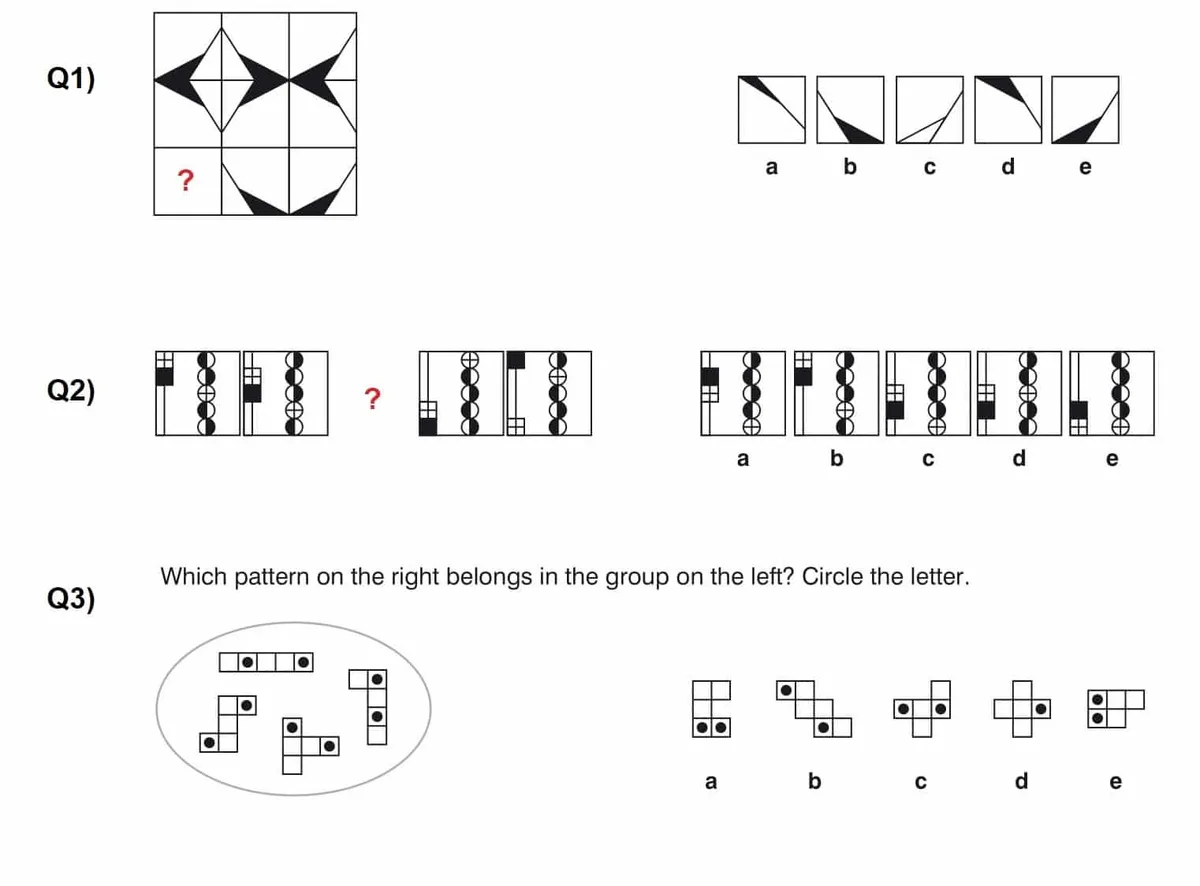
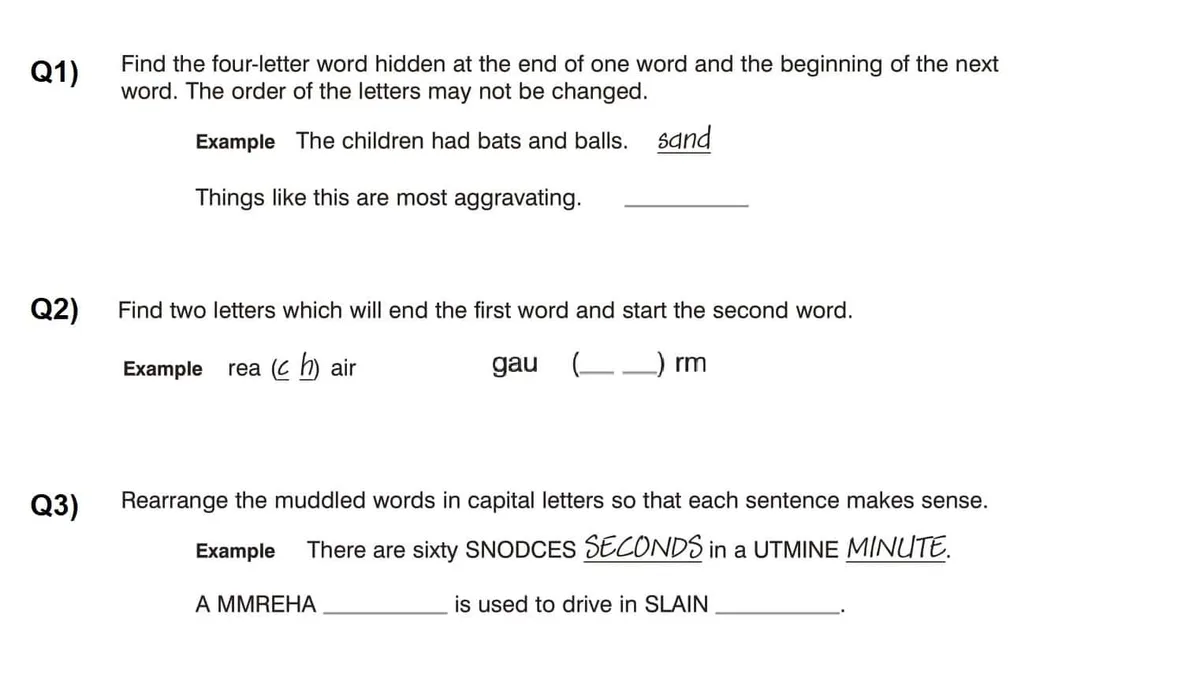
At this point you are probably wondering what these reasoning tests actually involve, since they appear in almost every test above and most South African children have never seen one.
Non-verbal reasoning asks your child to work out the rule governing a sequence of shapes, patterns or diagrams, and then apply it. Verbal reasoning does the same thing with letters, words and language: codes, analogies, letter sequences and word relationships.
The examples below are taken directly from an 11-year-old's entrance test.
Non-verbal reasoning
Verbal reasoning
These are psychometric-style questions, which leads a lot of parents to assume that practice will not move the needle. In our experience preparing students for these tests, that is wrong. Familiarity with the question types and the format materially improves scores, because a large part of what is being measured on a first encounter is simply whether the child has seen the format before.
Which test does my child need?
The short answer is to ask the school, in writing, and early. The longer answer, as a rough guide:
- Applying to a selective UK independent senior school, child currently in Grade 4 or 5: the ISEB Common Pre-Test is probably your first hurdle, sat in Year 6 or 7. Start here.
- Applying to UK independent schools from abroad, at almost any age from 9.5: the UKiset is usually the most efficient first move, because one sitting reports to up to five schools.
- Provisionally accepted by an independent school subject to results: you will be entered for Common Entrance at 11+ or 13+.
- Targeting a selective state grammar school: the state 11+, registered directly with the local authority or consortium, on their deadline.
- Some independent schools instead: CAT4, either alongside or in place of Common Entrance.
It is common to face more than one of these. It is also common for a school's stated requirements to differ from the general pattern, which is why the first step is always an email to the admissions office.
How to prepare for a UK entrance test
If the target school requires an entrance test, your child is unlikely to perform to their potential without preparation, for the two reasons set out above: their age-equivalent competition has covered more advanced mathematics and literacy, and those children have been drilled on these test formats for years.
So, what to do?
Your child needs to write mock entrance exams aligned to the actual test they will be taking, so you can see how they perform under the real format and where the weak areas genuinely are. Guessing at this is a waste of everyone's time and money.
They then need to be taught both the content and the exam technique. The content gaps are usually specific and closeable. The technique gaps, especially on adaptive tests where pace and difficulty interact, are often the larger win.
That's where we come in. We assess weak areas through mock entrance examinations as part of our assessment process, and we advise on whether a UKiset or similar is worth sitting at all for the schools you are targeting. We then fill those gaps systematically through premium, one-on-one tuition with our trained in-house team of tutors, online or in person.
Every programme is run by an Education Leader, a senior member of our team who designs the programme, chooses and supervises the tutor, and reports back to you through to the result.
Who is Genius?
Genius has been operating since 1993, supplementing the school system and preparing students for transitions to schools all over the world throughout that time.
We are not a tutoring agency. Our tutors are in-house instructors who have been through a rigorous vetting and training programme, and the tutors we use for entrance test preparation are trained on the specific test your child is sitting.
Here are some of the things that parents have said about our programme:
- The assessment process is convenient and pain-free.
- The lessons happen at a time that suits you, even if that means mornings or weekends.
- These are one-on-one lessons that happen in your home or online.
- You know which test your child should be sitting, and when.
- Your child walks into the exam room having seen the format before.
- Someone senior is accountable for the programme from beginning to end.
You can book an assessment by heading over to our contact page, or reaching us on hello@geniuspremium.com, or +27 11 467 9884. You can also read more about our syllabus transition and relocation tuition and see what our parents have to say.
Frequently asked questions
1. What is the ISEB Common Pre-Test?
An online, adaptive, age-standardised admissions test sat in Year 6 or Year 7, covering English, Mathematics, verbal reasoning and non-verbal reasoning in about two and a half hours. For most selective UK independent schools it is the first and often decisive stage of admission, and it is sat once and shared with the senior schools you have applied to.
2. What is the difference between the ISEB 11+ and the grammar school 11+?
They are different exams with the same name. The ISEB Common Entrance at 11+ is an independent-sector paper that a school enters your child for after provisionally accepting them. The state grammar school 11+ is run by local authorities and consortia, you register for it yourself on their deadline, and it is the only route into a selective state school.
3. How much does the UKiset cost?
£295 as at 2026, covering registration, the test, invigilation online or at a centre, the profile report, and reports to up to five schools of your choice. Check the current fee on the UKiset website before registering.
4. Can my child sit the UKiset from South Africa?
Yes. The majority of candidates sit it online from home through UKiset's secure online invigilation service, and accredited test centres can be arranged on request.
5. How often can my child re-sit the UKiset?
Every four months. Results are valid for one year from the test date.
6. What age can my child sit the UKiset?
Between 9.5 and 18 years old.
7. Does practice actually improve entrance test scores?
Yes. These are psychometric-style tests, which leads many parents to assume that preparation is pointless, but in our experience of preparing students, familiarity with the question types and the format materially improves scores. Much of what a first sitting measures is whether the child has seen the format before.
8. Do state schools in the UK have entrance exams?
Mostly no. State schools cannot select on academic ability, and places are allocated on published criteria such as distance from home and siblings. The exceptions are grammar schools, which select at 11, and a small number of partially selective or banded schools.
9. What is CAT4?
The fourth edition of GL Assessment's Cognitive Abilities Test, covering verbal, non-verbal, quantitative and spatial reasoning, for children from roughly age 6 to 17 and over. It measures cognitive potential rather than retained syllabus knowledge, which is why some independent schools prefer it, and why it can suit a child arriving from a different curriculum.
10. When should we start preparing?
As soon as you have a target school, and ideally a year before the test. For families aiming at selective independent senior schools that can mean starting in Grade 4 or 5, because the ISEB Common Pre-Test arrives in Year 6 or 7 and catches most South African families by surprise.